Well, guess ive taken too long a break, gonna restart to study the teachings. However will be posting the verses and any additional notes to my facebook page, there's better chance someone interested in practicing can get in contact with this precious teachings.
Here's the address of the page:
http://www.facebook.com/pages/The-Way-of-The-Bodhisattva/176310119065579
Saturday, December 18, 2010


Short Christmas Wish
This period of the year always bring back much sensations of joy and melancholy for me. The physical sensations of these two emotions are the same in actuality, only the thoughts that they are tagged to makes the label. On this Christmas, most will feel these same sensations, and it will be wonderful if they are tagged to the label of joy for everyone.
Share the love with someone, anyone. May there be peace and happiness. With metta, Merry Christmas.
Wednesday, December 8, 2010
Wednesday, December 1, 2010
Mindlessness at it's best!
Did something really ridiculous today. Really really ridiculous. This morning when I left my car, and was so preoccupied with taking the items from the boot, I left the car running and went off to the office. Yes the engine was still running when I returned 9 hours later to retrieve the car, and the key was there, and no one drove it away!
Such a mindless act! The first reaction that was caught was one of panic, as I walked towards the car, felt my pocket and realized the key was not there. Greeted this anxiety, and very quickly it left to allow its nemesis, Relief to enter. Well at least the car is still here! That was the thought. So quickly took a peek into the car and there it was, the key!
So I opened the door, and twisted the key, and shocked was I. Oh my goodness. The engine was running. Sat into the car and felt the heat, as well as the continuous stream of anxious thoughts. ‘Will the car explode? Why is it so hot? Is the radiator burning? Why is the heat meter still at average level?’ It goes on and on. Kleshas have this ability, when they start streaming, they never stop until an action is done. So I picked up the phone and called my brother who is working as a car mechanic. Though he assured that nothing will be wrong, the mind is half convinced, and continued on its stories all the way on the drive home.
Once it got tired of telling stories about the car, it turned its attention to itself. ‘How the hell could this have happened? Haven’t you been meditating every single day? Haven’t you been mindful of your breath throughout the journey? Haven’t you this haven’t you that?’ It’s astounding the number of questions arising in such a short span of time.
And, like the earlier stories, once the questions run its course they naturally stop. The only one that left behind, waiting to be contemplated on later on is ‘What is this teaching?’
It doesn’t bother a bit that such a mindless act can still happen, nor what will happen to the car after this, nor the fact that it doesn’t bother a bit. This is just another condition coming to fruition, while arising the way for some consequences in the future. One thing for sure is life will still go on, the fallibility of human behavior will still manifest, and no one is here to claim ownership of them.
Some other thought of someone dear in the past seems to be clinging on more strongly lately. Maybe this incident is a condition to contemplation on the more pressing attachment.
It’s gonna be a long night tonight. And hopefully the car can start tomorrow morning.
Wednesday, November 10, 2010
What is that? A Sparrow!
Loving-kindness starts with the people close to us. The ones who have been here for us all the while, regardless of who we are. When we are able to extend this love to our closest, then the heart is open to give, and receive the love of the world.
Saturday, November 6, 2010
Friday, November 5, 2010
Favourite Zen Stories
Zen stories are the windows to the wisdom that we seek. Not just in the conventional wisdom that is applicable in everyday life, but shifts the paradigm that the mind is used to seeing the world. The clarity of insight is evident when one reads the stories, and compares to previous encounters of the same stories. Here are some of my favourite stories. Taken from http://www.awakeblogger.com/2008/09/the-10-very-best-zen-stories/#more-789 and http://www.101zenstories.com/
A Cup of Tea
Nan-in, a Japanese master during the Meiji era (1868-1912), received a university professor who came to inquire about Zen.
Nan-in served tea. He poured his visitor’s cup full, and then kept on pouring.
The professor watched the overflow until he no longer could restrain himself. "It is overfull. No more will go in!"
"Like this cup," Nan-in said, "you are full of your own opinions and speculations. How can I show you Zen unless you first empty your cup?"
The following story is my all time favourite, one that she used to tell alot.
The Burden
Two monks were returning to the monastery in the evening. It had rained and there were puddles of water on the road sides. At one place a beautiful young woman was standing unable to walk accross because of a puddle of water. The elder of the two monks went up to a her lifted her and left her on the other side of the road, and continued his way to the monastery.
In the evening the younger monk came to the elder monk and said, "Sir, as monks, we cannot touch a woman ?"
The elder monk answered "yes, brother".
Then the younger monk asks again, "but then Sir, how is that you lifted that woman on the roadside ?"
The elder monk smiled at him and told him " I left her on the other side of the road, but you are still carrying her."
Cliffhanger
One day while walking through the wilderness a man stumbled upon a vicious tiger. He ran but soon came to the edge of a high cliff. Desperate to save himself, he climbed down a vine and dangled over the fatal precipice.
As he hung there, two mice appeared from a hole in the cliff and began gnawing on the vine.
Suddenly, he noticed on the vine a plump wild strawberry. He plucked it and popped it in his mouth. It was incredibly delicious!
The Blind Men and the Elephant
Several citizens ran into a hot argument about God and different religions, and each one could not agree to a common answer. So they came to the Lord Buddha to find out what exactly God looks like.
The Buddha asked his disciples to get a large magnificent elephant and four blind men. He then brought the four blind to the elephant and told them to find out what the elephant would "look" like.
The first blind men touched the elephant leg and reported that it "looked" like a pillar. The second blind man touched the elephant tummy and said that an elephant was a wall. The third blind man touched the elephant ear and said that it was a piece of cloth. The fourth blind man hold on to the tail and described the elephant as a piece of rope. And all of them ran into a hot argument about the "appearance" of an elephant.
The Buddha asked the citizens: "Each blind man had touched the elephant but each of them gives a different description of the animal. Which answer is right?"
The Dead Man's Answer
When Mamiya, who later became a well-known preacher, went to a teacher for personal guidance, he was asked to explain the sound of one hand.
Mamiya concentrated upon what the sound of one hand might be. "You are not working hard enough," his teacher told him. "You are too attached to food, wealth, things, and that sound. It would be better if you died. That would solve the problem."
The next time Mamiya appeared before his teacher he was again asked what he had to show regarding the sound of one hand. Mamiya at once fell over as if he were dead.
"You are dead all right," observed the teacher. "But how about that sound?"
"I haven't solved that yet," replied Mamiya, looking up.
"Dead men do not speak," said the teacher. "Get out!"
A Buddha
In Tokyo Imperial University
One day Unsho visited Tanzan, who was drinking wine at the time, not even a drop of which is supposed to touch the tongue of a Buddhist.
"Hello, brother," Tanzan greeted him. "Won't you have a drink?"
"I never drink!" exclaimed Unsho solemnly.
"One who does not drink is not even human," said Tanzan.
"Do you mean to call me inhuman just because I do not indulge in intoxicating liquids!" exclaimed Unsho in anger. "Then if I am not human, what am I?"
"A Buddha," answered Tanzan.
No Water, No Moon
When the nun Chiyono studied Zen under Bukko of Engaku she was unable to attain the fruits of meditation for a long time.
At last one moonlit night she was carrying water in an old pail bound with bamboo. The bamboo broke and the bottom fell out of the pail, and at that moment Chiyono was set free!
In commemoration, she wrote a poem:
In this way and that I tried to save the old pail
Since the bamboo strip was weakening and about to break
Until at last the bottom fell out.
No more water in the pail!
No more moon in the water!
Thursday, November 4, 2010
Well Wishes 2 :)
How time stays still. 1 year has passed since.
First of all, would like to wish soonsoon happy birthday again on this blog, May happiness and peace be with him and beebee.
The 4 of us had coffee last night. The banter was on, but the mood had starkly changed. How 1 year's happenings can change each of us, it's a drama in its own right. Change waits for no one, for there is no one to wait for. One might try to hang on, only to find the rope to be an illusion.
One thing is for sure. It shall be different again next year.
Hopefully it doesn't feel as dark as what's written today.
Metta.
First of all, would like to wish soonsoon happy birthday again on this blog, May happiness and peace be with him and beebee.
The 4 of us had coffee last night. The banter was on, but the mood had starkly changed. How 1 year's happenings can change each of us, it's a drama in its own right. Change waits for no one, for there is no one to wait for. One might try to hang on, only to find the rope to be an illusion.
One thing is for sure. It shall be different again next year.
Hopefully it doesn't feel as dark as what's written today.
Metta.
Sunday, October 31, 2010
Quietening the Inner Chatter
Nice descriptive pointers taken from http://themindfulmoment.blogspot.com/2010/10/quietening-inner-chatter-part-1.html
 The inner chatter in our minds is something we are all familiar with. While we may have good and sometimes bad experiences in our lives that may move us to ponder life's deeper meanings or to seek out answers it is this inner chatter, more-so out of it's insistent and consistent barrage on our minds, that we are finally driven to seek out someway to quieten it down. It gets so unrelenting and so persistent that once we have decided that we have had enough of it and we want to quieten it down, there doesn't appear to be any way to stop it. We can't even go to sleep because the mind just keeps going and going!! It's like torture "Okay, I'm over this noise in my head now. I think you should stop now. Okay, stop. No no, I mean stop .... now! Shhh! I really mean it. Come on now, stop!!! STOP!!!"
We quickly realise as much as we want it to stop it just seems to keep going. We try frantically to find ways to quieten the mind but none of it seems to make the slightest bit of difference. We'll typically at this point turn to all kinds of external means to find some peace and we'll drown it out with social activities, making ourselves busy, through entertainment media like TV, radio, music, x-box or even alcohol and drugs. These only serves as a means of distracting us from the noise. As soon as we remove the distraction the noise and inner chatter is back as loud as ever. Actually over time doing these distraction techniques just make the inner chatter worse by perpetuating the cycle. So how do we stop it? Well really the secret is not to stop it, I'll explain more as we go.
If we are lucky, in our search for a solution, we may eventually stumble across meditation. The common problem is people try it and think that meditation is about stopping the thoughts. It's a very common misconception and unfortunately leads a lot of people to try it and then walk away thinking it didn't yield any results. This is why I'm writing this article, to help bring some understanding to what is happening here. People often read a few blogs, a website or two, a book maybe or chat to someone about the basics of meditation and then sit down to try meditation only find it doesn't work. Or so they think!
In talking to people about meditation I find lots of people have tried it. This is really heartening to see. You can see they too are seeking some peace and along the way have tried meditation as a means of finding this peace. One of the main recurring themes I hear is that people say "Oh I tried meditation but it didn't work" or "I couldn't do it". My immediate response is usually "This is like water saying, I just don't know how to be wet". It's impossible for meditation not to work!! It has to work because it is by it's very fabric the nature of all things, including ourselves, our minds and consciousness. I'll explain this below as we go.
Momentum
 It is important to take a step back and ask ourselves first "What has lead me to have this mind and all this inner chatter?" and to really evaluate what is going on. It is through wanting, conceptualising, grasping, categorising, judging, pushing away, and thinking about everything we experience in life that our minds become busy. In our day to day we have a thought arise about every thing little, every teeny tiny thing and what we thinkabout it, how we feel about it, what it means to us and how we can get more of it orget away from it. Through this there is a perpetuating cycle of mind busyness which over times results in a momentum all of it's own. It's like a freight train that's been gathering more carriages along its journey. The heavier it gets the harder it is to stop. After a while it has so much momentum that even when the train driver sticks on the brakes the train will just keeping on skidding and take a long time to come to a stop!!! Our minds are just like this. We stick on the brakes expecting it to stop and, "Holy crap! It's still going!"
What is Meditation About?
So we have to be very clear, meditation is not about stopping thoughts. We cannot approach meditation with another "want", but often this is exactly what we do. "I want to do meditation to find some peace" or "I want to do meditation to be happy" or "I want to do meditation to stop this inner chatter in my mind". Again however this is the same cycle we just stated above. In doing so we've just approached meditation in the same way we've approached everything else in our lives, and in trying it like this we continue to perpetuate the cycle of inner chatter. So of course we walk away thinking "Well that stinks, it doesn't work". Meditation is not about getting what you want, meditation is about letting go. As you do this thoughts stop by themselves!
Ajahn Chah's has a little book of quotes called No Ajahn Chah: Reflections in which he says:
I'll explain exactly how that works in Part 2 and then in Part 3 what we can do to quieten the inner chatter, the common trap and how to apply this. Check back tomorrow for Part 2.
Quietening the Inner Chatter - Part 1
Labels: acceptance, attachment, challenges, conditioning, cycles, death, dependent origination, desire, existance, happiness, healing, karma, meditation, nature, peace,silence, sleep, suffering, thoughts

We quickly realise as much as we want it to stop it just seems to keep going. We try frantically to find ways to quieten the mind but none of it seems to make the slightest bit of difference. We'll typically at this point turn to all kinds of external means to find some peace and we'll drown it out with social activities, making ourselves busy, through entertainment media like TV, radio, music, x-box or even alcohol and drugs. These only serves as a means of distracting us from the noise. As soon as we remove the distraction the noise and inner chatter is back as loud as ever. Actually over time doing these distraction techniques just make the inner chatter worse by perpetuating the cycle. So how do we stop it? Well really the secret is not to stop it, I'll explain more as we go.
If we are lucky, in our search for a solution, we may eventually stumble across meditation. The common problem is people try it and think that meditation is about stopping the thoughts. It's a very common misconception and unfortunately leads a lot of people to try it and then walk away thinking it didn't yield any results. This is why I'm writing this article, to help bring some understanding to what is happening here. People often read a few blogs, a website or two, a book maybe or chat to someone about the basics of meditation and then sit down to try meditation only find it doesn't work. Or so they think!
In talking to people about meditation I find lots of people have tried it. This is really heartening to see. You can see they too are seeking some peace and along the way have tried meditation as a means of finding this peace. One of the main recurring themes I hear is that people say "Oh I tried meditation but it didn't work" or "I couldn't do it". My immediate response is usually "This is like water saying, I just don't know how to be wet". It's impossible for meditation not to work!! It has to work because it is by it's very fabric the nature of all things, including ourselves, our minds and consciousness. I'll explain this below as we go.
Momentum

What is Meditation About?
So we have to be very clear, meditation is not about stopping thoughts. We cannot approach meditation with another "want", but often this is exactly what we do. "I want to do meditation to find some peace" or "I want to do meditation to be happy" or "I want to do meditation to stop this inner chatter in my mind". Again however this is the same cycle we just stated above. In doing so we've just approached meditation in the same way we've approached everything else in our lives, and in trying it like this we continue to perpetuate the cycle of inner chatter. So of course we walk away thinking "Well that stinks, it doesn't work". Meditation is not about getting what you want, meditation is about letting go. As you do this thoughts stop by themselves!
Ajahn Chah's has a little book of quotes called No Ajahn Chah: Reflections in which he says:
Remember you don’t meditate to "get" anything, but to get "rid" of things. We do it not with desire but with letting go. If you "want" anything, you won’t find it.By this he doesn't mean to get rid of something we don't want or we remove something that we want to get away from. He's not saying to get rid of the inner chatter or noise.
I'll explain exactly how that works in Part 2 and then in Part 3 what we can do to quieten the inner chatter, the common trap and how to apply this. Check back tomorrow for Part 2.
Sunday, October 10, 2010
Advice on Treading the Buddhist Path
By BuddhismNow. Follow them on Twitter @buddhism_now.
http://buddhismnow.wordpress.com/advice/

http://buddhismnow.wordpress.com/advice/
Advice
Advice on Treading the Buddhist Path
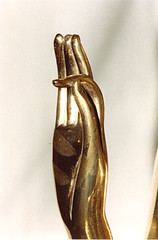
Variant of Varada mudra, left hand has fingers pointing down.
The Buddha’s teaching was given to help people find true happiness by putting an end to suffer ing. True happiness is attained by doing certain things and leaving certain things undone. The following has been adapted from various sources on how to tread the Buddhist path.
To make far-reaching plans as though we were going to establish permanent residence in this world, instead of living as though each day were the last, is foolish.
Sorrow and misfortune are teachers that convince us of the need to lead a religious life.
Reflecting upon the miseries which all sentient beings suffer will encourage us to attain liberation.
There is no real happiness outside of enlightenment.
It should be realised that all sorrows are the result of past actions.
Reflecting upon the nature of cause and effect will encourage us to avoid unskilful and unwise actions.
Avoid those actions which harm the mind and impede spiritual development.
Freedom from desire and attachment is necessary if we wish to be free of suffering.
Refrain from harming any living thing.
Eating meat is like eating one’s own chil dren.
We should consider that all sentient beings are no other than the Buddha himself.
Refrain from earning a living by means of deceit and theft.
Unless all ambitions are eradicated, we are likely to fall into the error of allowing ourselves to be dominated by worldly motives.
It is useless devoting our lives to the acquisition of worldly things, seeing that when death comes we must relinquish even our own bodies.

Act so that you have no cause to be ashamed of yourselves, and hold fast to this rule.
Instead of hankering after the transitory pleasures of this life, we should devote ourselves to realising the eternal bliss of nirvana.
To enjoy a single moment of nirvanic bliss is more precious than to enjoy any amount of sensual bliss.
Be content with simple things and be free from craving for worldly possessions.
Hurt none by word or deed.
Reason, being one’s best friend, should not be abandoned.
It is not only necessary to understand the teaching; it is also necessary to apply it to our own needs.
Awareness and humility are required to keep body, speech and mind free from defilement.
A team of the fastest horses cannot overtake a word once it has left the lips.
Don’t ever dispute on religious belief.
Constantly maintain alertness of mind in walking, sitting, eating and sleeping.
It is good to train the wandering mind. A mind under control brings great happiness.
If great attachment, craving, or unwhole some mental states arise, make an effort to eradicate them as soon as possible.
It is good to abandon attachment to all things and attain knowledge of reality.
Cultivate friendliness, compassion, and wisdom.
Reflecting upon death and the imperma nence of life will encourage us to live skilfully and without blame.
We can only acquire knowledge of the path by treading it.
Reflecting upon the uselessness of aimlessly frittering away our lives will encourage us to tread the path diligently.
To enter upon the path and not to tread it is foolish.
To know the precepts and not apply them to clearing away defilement is to be like a sick man who never takes his medicine.
To be idle and indifferent when the circum stances are favourable for realisation is foolish.
To be clever concerning precepts, yet ignorant of the experiences which come from applying them, is to be like a rich man who has lost the key of his treasury.
To enter upon the path and to cling to worldly feelings of attraction and aversion is foolish.
To live hypocritically is as stupid as poison ing our own food.
Without practical and adequate understand ing of the teaching, we are likely to fall into the error of religious self-conceit.
Don’t despise a beginner if you are a seeker of supreme enlightenment. Never say to anyone: You will not obtain superior knowledge.
Trying to reform others instead of reform ing ourselves is an error.
Let go!
Once spiritual knowledge has dawned, do not neglect it through laziness, but cultivate it vigorously.
Avoid concealing one’s own faults and broadcasting the faults of others.
Don’t boast of your own attainment, but apply it to the realisation of truth.
By permitting credulous admirers to congre gate about us, we are likely to become puffed up with worldly pride.
Performing good actions merely to attain fame and praise is like exchanging the mystic wish-granting gem for a pellet of goat’s dung.
To cunningly praise ourselves while dispar aging others is foolish.
To devote ourselves to selfish ambitions instead of working for the good of others is as foolish as a blind man allowing himself to become lost in a desert.
See all beings as on the way to their slaugh ter.
Fools think they harm themselves by putting others first.
One does no good to oneself by taking advantage of others.
If we slight others we harm ourselves.
Unless we are selfless and compassionate, we are likely to fall into the error of seeking liberation for ourselves alone.
If only the good of others is sought in all that we do, then it will be realised there is no need to seek any benefit for ourselves.
Helping others, however limited our abilities may be, should not be avoided.
The mind, imbued with compassion in thought and deed, should always be directed to the service of all sentient beings.
Reflecting upon the evils of life in the round of successive existences will encourage us to seek freedom from birth and death.
To spend our lives oscillating between hope and fear instead of understanding reality is an error.
Supreme enlightenment is easy to know—just cut yourself off from seizing upon false views.
When we understand the teachings, it is the same whether we meet with good fortune or with bad.
Those who tread the path should be indiffer ent to both comfort and hardship.
When we realise that all phenomena are illusory, then we realise there is no need to seek or reject anything.
When we are truly compassionate, it is the same whether we practise meditation in solitude or work for the good of others in the midst of society.
It is a great joy to realise that the path to freedom, which all the buddhas have trodden, is ever-present, ever-unchanged, and ever-open to those who are ready to enter upon it.
Straightforward action will lead us to liberation directly.
Study the teachings of the great sages of all sects impartially.
~~~~~~~~~ ~~~~~~~~~ ~~~~~~~~~
Books used
Dhammapada, J. Austin, (ed.), 1983, The Buddhist Society, London.
The Large Sutra on Perfect Wisdom, E. Conze, 1975, University of California Press.
The Path of Freedom, Rev. N.R.M. Ehara, et al., 1977, BPS.
Tibetan Yoga and Secret Doctrines, W.Y. Evans Wentz (ed.), 1969, OUP.
Tibet’s Great Yogi Milarepa, W.Y. Evans-Wentz (ed.), 1969, OUP.
The Diamond Sutra and the Sutra of Hui Neng, Wong Mou-Lam (trans.), 1969, Shambhala.
The Lankavatara Sutra, D.T. Suzuki (trans.), 1973, RKP.
Subscribe to:
Posts (Atom)